Persona-Building Kits
How Might We Make Persona Development Faster and More Inclusive?
We needed to streamline and standardize the user-persona development process. User personas are fictional, yet realistic, representations of a target user for a product or service, developed based on research and data. Product teams often relied on researchers to create personas.
The persona-building process was time-consuming, and personas built for one project rarely transferred to others. They also tended to focus on “typical” users, which risked excluding underrepresented groups. Inspired by frog’s Cards for Humanity, I set out to build a flexible, inclusive persona kit—one that helped teams generate personas quickly, with optional inclusive traits built in.
| My Role | Initiated the project by guiding two summer interns in building a prototype kit, later led a team of three researchers to further develop the kit, and collaborated with two designers and a content designer to refine it |
|---|---|
| Timeline | About a year (2023 summer & 2024 Q2–Q4) |
| Methods | Iterative development through continuous pilot testing |
| Deliverables |
|
| Tools Used | Miro, Figma |
| Company | Sam’s Club |
|---|---|
| Stakeholders | Product, Design, Research |
| Outcomes |
Customer, store or fulfillment-center associate, and corporate associate persona templates published
Adopted in product development and design-thinking workshops
Used in working sessions at the 2024 Re:imagine Retail conference
|
From Intern Prototype to Production Kits
Summer Intern Project
I guided two research interns in developing a store-associate persona template. They piloted it in two departments in the store and finalized the template. They created a short video clip of how to use the template. The interns' persona template consisted of two parts: Job Nature and Persona’s Perspectives. The former included operating principles, working environments, tools, and activities; and the latter included tenure at work, disabilities, and pain points. The interns presented their work to the UX team and shared the template and the video clip.
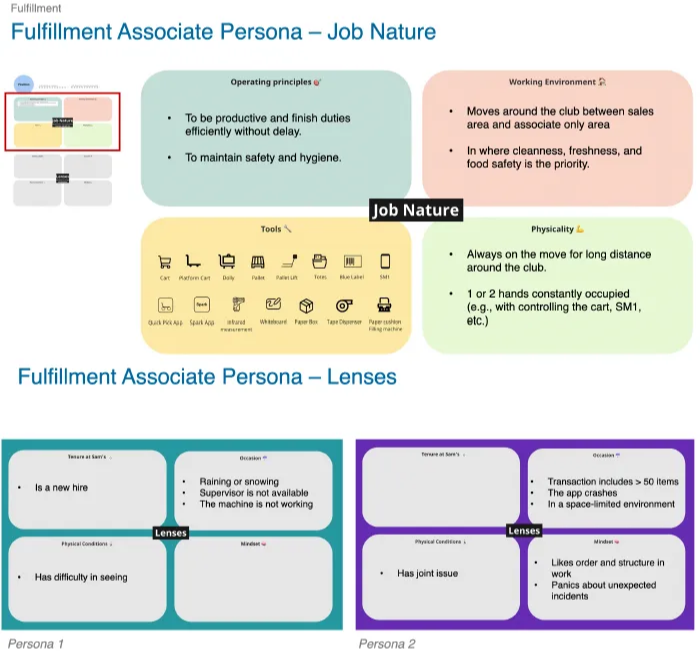
Store-associate persona prototype developed by two summer interns
Expansion
After the interns' pilot, three researchers joined the effort. We reviewed existing personas and distilled their attributes. Working sessions and additional user interviews helped us identify where kits should diverge. We put together persona prototypes and tested in a real project, which helped us prioritize which attributes we needed to include. For example, personal circumstances (e.g., gender, family size) could be meaningful in customer personas, but not as much for associate personas. We also learned that simpler options would be useful, so we created both detailed and abbreviated formats. Each kit covers a distinct user group with components tailored to that context:
| Customer | Store or Fulfillment-Center Associate | Corporate Associate |
|---|---|---|
| Demographics, Goals, Contexts, Pain points, User needs, Accessibility needs | Job details, Key objectives, Tools utilized, Pain points, User needs, Demographics, Accessibility needs | Job details, Key objectives, Tools utilized, Pain points, User needs, Demographics, Accessibility needs |
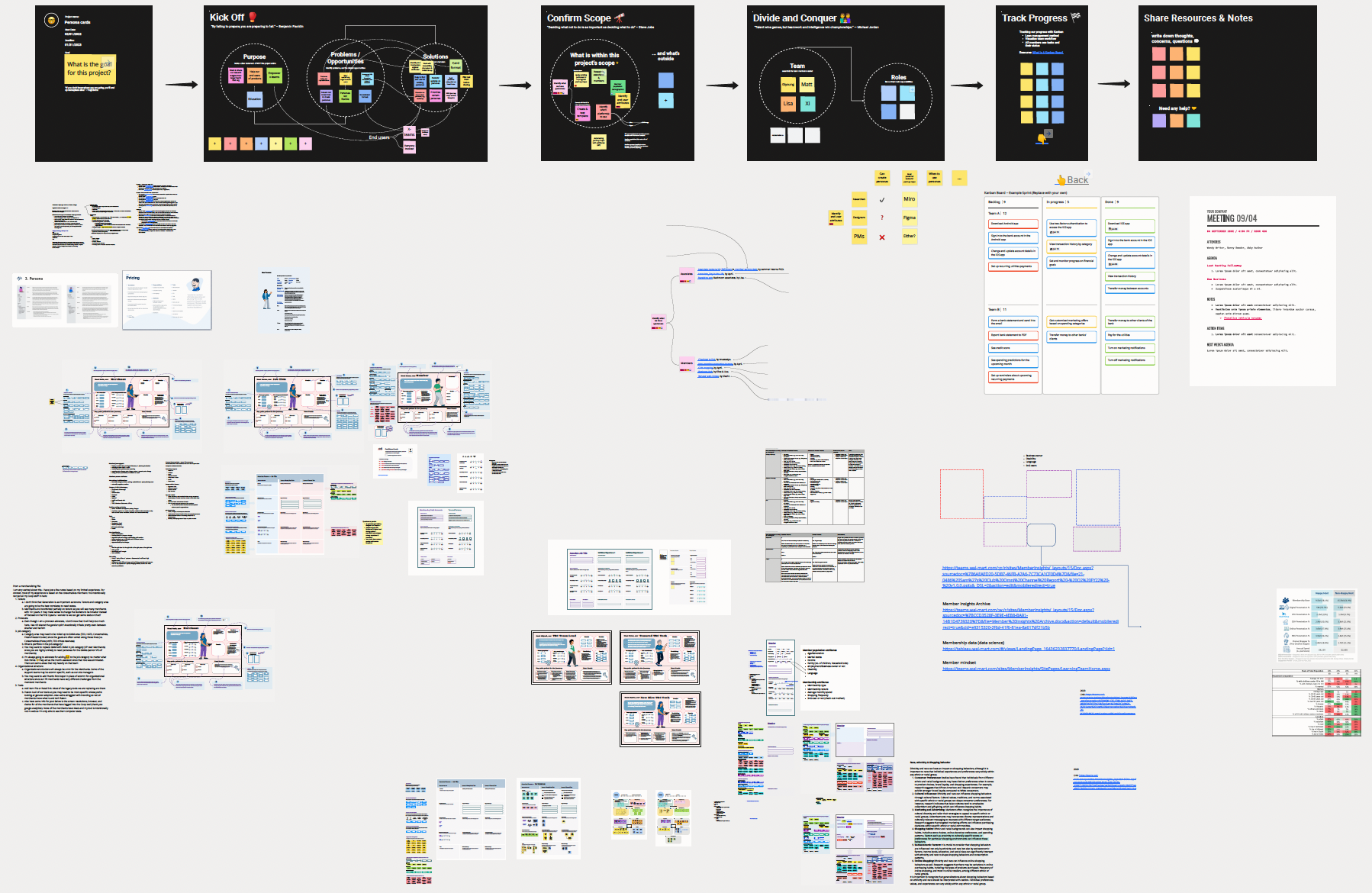
Project board tracking scope, team assignments, and progress across three persona kit types
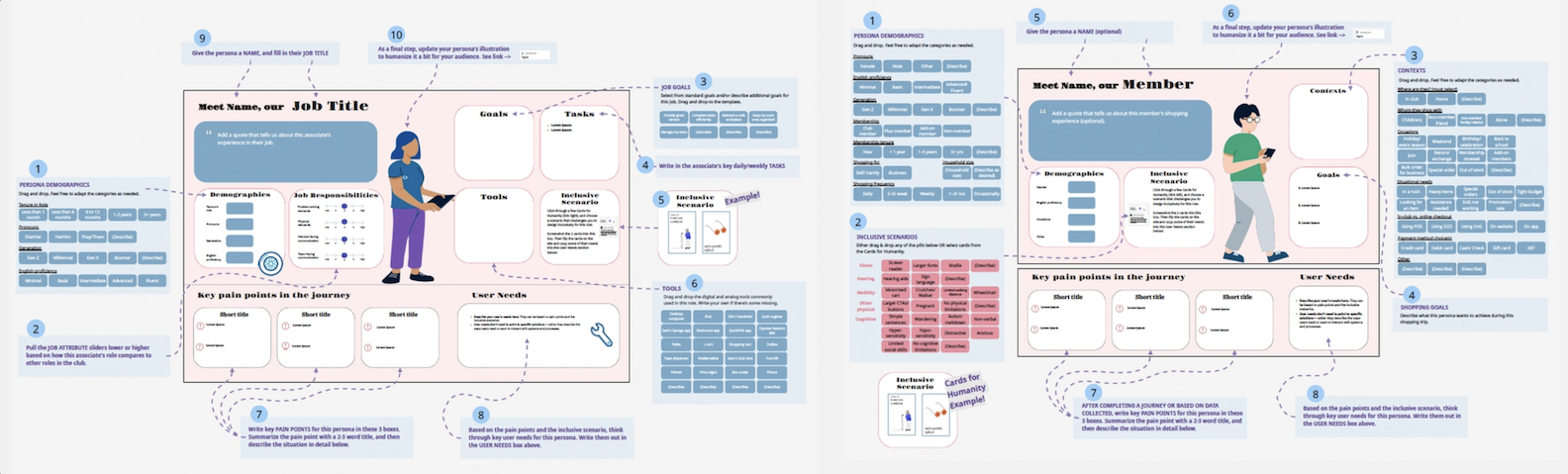
Draft store-associate and customer persona templates with step-by-step instructions and inclusive scenario examples from Cards for Humanity
Polishing the Kits
Two product designers and one content designer joined to refine the kits. They improved the language, built interactive templates in Figma, and added selectable visuals to make the experience more engaging and easier to use.
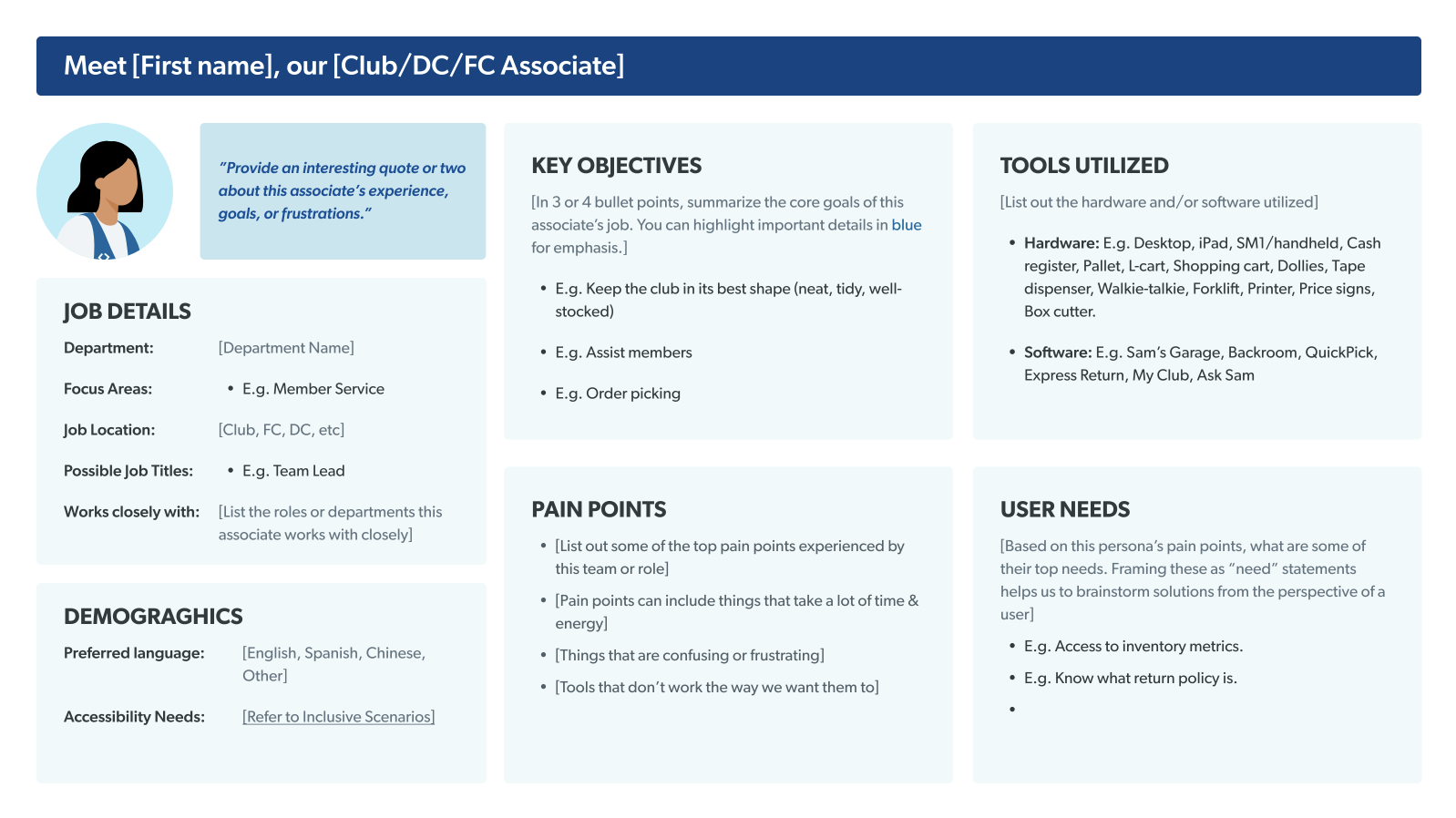
Polished, detailed-version template with dropdown options for store, fulfillment-center, and distribution-center associate personas
Adopted Across Teams and Working Sessions
- The kits were adopted in product development, design-thinking workshops, and working sessions at the 2024 Re:imagine Retail conference.
- Teams created personas more efficiently and inclusively, without needing extensive research support.
- Contributed to the Research Enablement program and the organization’s data-driven decision-making culture.
Expanding Awareness and Ease of Use
We gathered feedback from stakeholders through the Research Enablement program's focus groups and identified a few next steps:
Inclusive by Design, Not as an Afterthought
Conventional personas are built around the most typical user. That can be useful, but it systematically underrepresents people whose needs sit at the edges of the distribution, e.g., older adults, people with disabilities, non-English speakers, users in atypical contexts. These groups are often the ones whose experience breaks first when a product isn’t designed thoughtfully.
The kits address this directly: each template prompts teams to create multiple personas per project and includes inclusive attributes as a built-in option rather than an add-on. The “no special needs” selection exists, but the default framing asks teams to consider it. These kits not only make persona-building faster but also make inclusive design a routine part of the process rather than a separate initiative.