Sensory Well-being Hub
How Might We Create a Dedicated Sensory Space for Diverse Learners?
People with developmental disabilities (e.g., autism spectrum disorders or ASD, intellectual disability) are more likely to experience atypical sensory processing (Crane, Goddard, & Pring, 2009; Leekam, Nieto, Libby, Wing, & Gould, 2007; White, Oswald, Ollendick, & Scahill, 2009). Some are hypersensitive to stimuli; others have difficulty registering them. School classrooms have higher levels of sensory stimulation than students' home environments, which can lead to sensory overload. The school knew a dedicated sensory room would mitigate overstimulation. Proprietary solutions were unaffordable, and the school did not have a designated space for respite.
The project was selected as our firm’s pro bono design initiative of the year. We created initial design concepts, then invited six experts in atypical sensory processing to review the early design at a scientific advisory summit. Drawing on their input and literature reviews, we developed 10 design criteria to guide the hub design. Designers and researchers co-created and built the hub over the summer. Before the hub opened, we facilitated orientation sessions with special education teachers and staff, walking them through the space and how to use each sensory element. The research team conducted an academic-year-long evaluation.
| My Role | Lead Researcher |
|---|---|
| Timeline | 1 year and 6 months (2018–2019) |
| Methods | Literature reviews, Surveys, Focus groups, Contextual inquiry, Unobtrusive observations, Prototype testing, Behavior mapping, Archival data analysis, Scientific advisory summit |
| Deliverables |
|
| Tools Used | SPSS, Microsoft Excel, Hard copies for surveys, Proprietary behavior mapping tool, QuestionPro |
| Company | HKS Architects |
|---|---|
| Teams | Interior Design, Research, External partners (tensile fabric, media wall) |
| Stakeholders | Design, Research, Students, Teachers, Staff, Caregivers, External partners |
| Research Questions | 01How do diverse learners, teachers, and staff members use the hub?
02Which sensory elements are used most frequently?
03How do students with ASD versus without ASD respond to specific sensory elements?
04How do individuals with specific sensory profiles use the hub?
05What is the effect of the hub on the well-being of students, parents, teachers, and staff?
|
| Outcomes |
Sensory Well-being Hub opened and operated one full year
A modular, adaptable, and scalable prototype created and shared
|
Triple Diamond Design–Research Process
We structured the project around an integrated design–research process we call the triple diamond, built upon the Design Council’s double-diamond model. We added prototyping and evaluation to the diverging and converging process, reflecting our commitment to feeding findings back into the design rather than treating delivery as the end point.
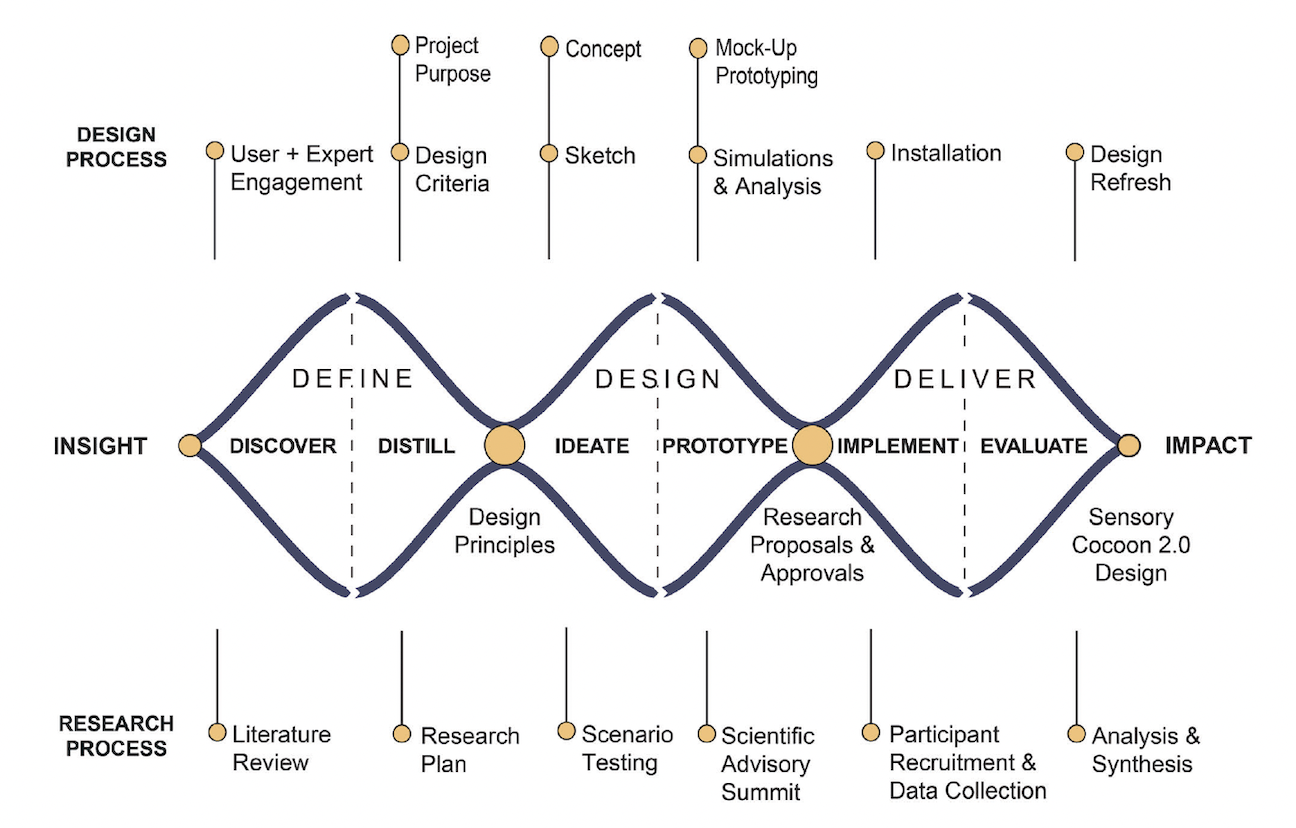
Triple-diamond framework mapping design activities in the upper track and research activities in the lower track along three diverge-converge cycles (image excerpted from the published journal article: https://doi.org/10.1111/joid.12164)
Building a Hub for Diverse Sensory Needs
Design Criteria
After literature reviews, we created design concepts and held a scientific advisory summit. Six experts in atypical sensory processing came to our office to review the early design. Drawing on their input and literature reviews, we developed 10 design criteria to guide the hub design.
| Criterion | Description |
|---|---|
| Quality and Safety | "Do no harm" by providing a safe place for students |
| Separate but Accessible | Easily accessible from classroom, but separate to minimize disturbance |
| Tunable Environment | Adjustable environmental attributes, such as sound and light |
| Sensory Affordance | Supports a range of sensory stimulations across modalities |
| Intuitive | Easy to use; does not require instructions |
| Affordable and Non-proprietary | Built with local materials, services, and elements |
| Versatile | Multi-functional, offering stimulation and respite |
| Modifiable | Sensory elements can be changed as needed |
| Scalable | Accommodates different spaces and budgets when reproduced |
| Durable | Withstands aggressive outbursts and forceful handling |
Final Design
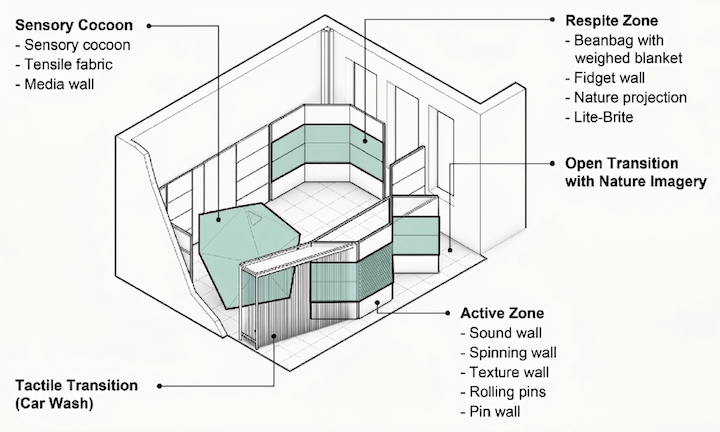
Sensory hub layout with three zones (active, respite, and cocoon) and two entryways (image excerpted from the published journal article: https://doi.org/10.1111/joid.12164)
Data Collection and Analysis
Participants
- Of 59 students in the school’s special education program (ages 14–21), 29 initially consented. Four later dropped (reached age 22 or transferred), leaving 25 participants (20 males, 5 females; mean age 16.7).
- 12 with ASD; 14 with intellectual disability ranging from mild to severe.
- 8 consented students, 4 teachers, and 6 staff members participated in focus groups.
- Log-in and media wall data captured visits from all 43 students who used the hub, not only those who consented.
Data Collected
| Source | What was collected | Sample size |
|---|---|---|
| Environmental sensors |
|
Millions of data points |
| Focus groups | Two teacher groups, two staff groups, and three student groups, describing hub usage and preferred sensory elements | n = 8 consented, high-functioning students, 4 teachers, 6 staff (18 total) |
| Usage logs |
|
n = 444 total logged visits; n = 43 students |
| Behavior mapping |
|
n = 60 |
| Media wall sensor data |
|
n = 167 |
| Sensory profile surveys | Adult/Adolescent Sensory Profile (AASP; Brown & Dunn, 2002): 60-item, 5-point Likert scale across four quadrants | n = 15 of 25 consented, high-functioning students |
Hub Used Primarily for Calming and Respite, With Divergent Preferences by Diagnosis
Environmental & Occupancy Sensor Data
- Median sound intensity was 3 dB(A) lower inside the cocoon than in the other zones, which was a non-negligible difference on a logarithmic scale.
- Illumination levels fluctuated greatly throughout the day; they were lower in the sensory cocoon by a median of ~4 lx than in the adjoining classroom.
- Temperature and relative humidity were stable across all zones and within recommended ranges.
- Occupancy sensor data indicated usage patterns that were not included in the logged visit data. The school confirmed that some students in the general education program also used the hub.
Analysis: Descriptive statistics
Notes: Used median values, not means, because observed sound intensity levels were sometimes lower than what the sensors could assess.
Hub Used Mainly for Respite
- Teachers and staff primarily perceived and used the hub as a resource for overstimulation and hypersensitivity, but not for hyposensitivity.
- 13 out of 59 students had scheduled visits to prevent sensory overload, which accounted for 41% of hub visit log entries vs. 25% student-initiated and 9% following an outburst.
- Students reported visiting the hub for calming down, relaxing, and feeling better when distressed by noise and other students' behavior in the classroom.
- The school’s policy was to limit hub visits to 10 minutes, which aligned with the dwelling times logged by staff.
Analysis: Descriptive statistics, Content analysis, Thematic analysis
Sensory Element Usage
- Compression, proprioception, and tactility were most sought.
- Beanbag with weighted blanket (39% of logged visits, in respite zone), sensory cocoon with tensile fabric and media wall (24%), and fidget wall (23%, in respite zone) were most used.
- Students used some elements in unexpected ways, e.g., small bags of grains for tactile engagement were more frequently used to hear the sound of the grains.
- A few students developed routine element use sequences during scheduled visits.
- Behavior mapping found that brief element interactions were often unlogged, particularly active zone elements, such as the sound wall and trampoline.
Analysis: Descriptive statistics
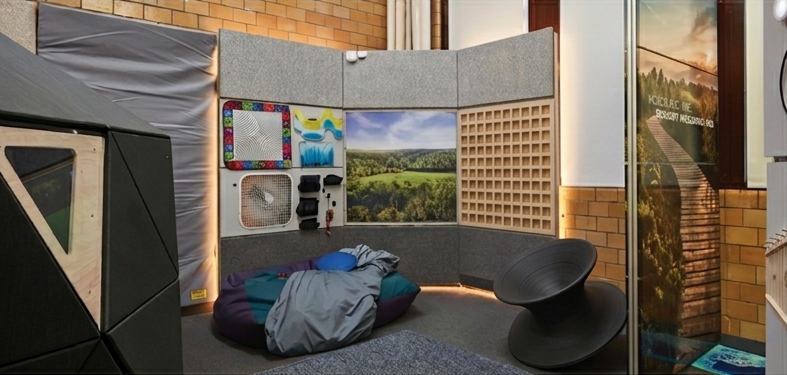
Respite zone
ASD vs. Non-ASD: Sensory Element Usage
- Students with and without ASD had equivalent sensory profiles but divergent usage patterns. ASD students were 2.23× more likely to use the sensory cocoon during scheduled visits.
- ASD students were less likely to use the beanbag, sound wall, and pin wall. They used the pin wall and sound wall mainly during unscheduled (distress) visits.
- The aquadoodle was used exclusively by students with ASD. Individual variation was substantial even within each group.
Analysis: Repeated-measures logistic regression
Sensory Cocoon Usage
- The mean dwelling duration in the sensory cocoon was 3 minutes 45 seconds (n = 167 visits overall).
- Media wall sensor data indicated that students sat 61% of the dwell time and lay down for 32%.
- One of the students reported that he felt he was too heavy to sit on the tensile fabric.
- Staff reported that some students quickly learned how to use the media wall while others needed help.
- Teachers and staff reported they occasionally had technical difficulties with the media wall.
- The permanently installed tensile fabric inside the cocoon limited wheelchair users' cocoon usage.
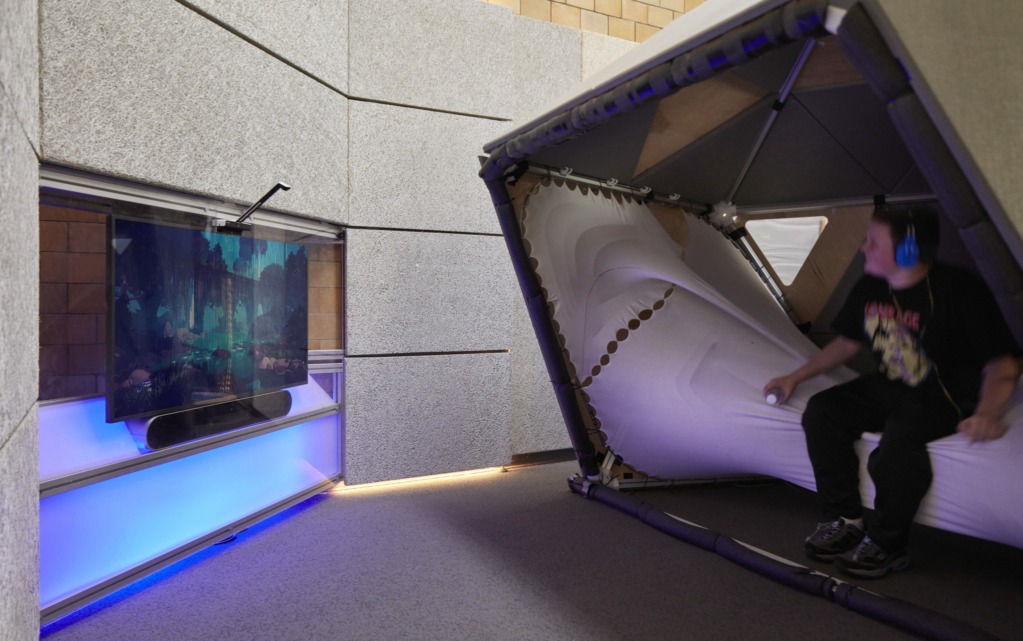
Sensory cocoon
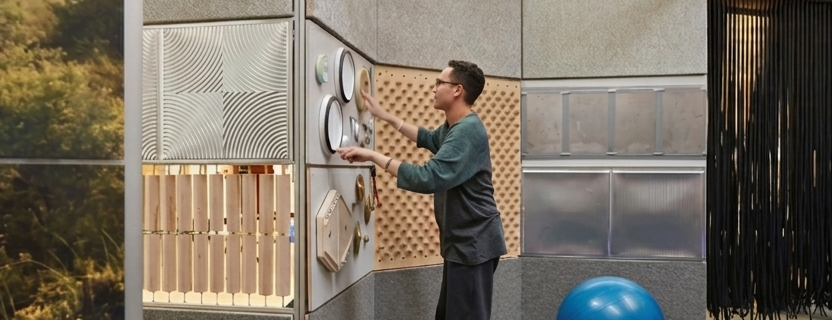
Active and Respite Zone Usage
- Staff guided students with severe cognitive impairments to tactile elements in active zone; higher-functioning students liked engaging with visual and auditory elements.
- Individual variation extended to element rejection: one student disliked the car wash; another disliked the trampoline.
- Three students in the focus groups appreciated the metal texture wall (active zone), but it was neither logged nor mentioned by staff due to students' brief interactions with it.
- One of the students, who had obsessive–compulsive disorder, dismantled the Lite-Brite (respite zone) because he could not stand a corner of the panel peeling off, indicating that minor imperfections can disturb neurodiverse students.
Analysis: Descriptive statistics, Content analysis, Thematic analysis
Active zone
A Replicable Model for Inclusive Design
- A modular, adaptable sensory hub was installed and operated successfully.
- Hub efficacy was assessed in a real school setting through a year-long, multi-method evaluation including environmental and occupancy sensor data, depth camera data, usage logs, behavior mapping, focus groups, and surveys.
- The hub provided students with a dedicated space for sensory regulation and respite during the school day.
- Both special education and general education students used the hub.
- Hub design and instructions were published as open source to help other schools and organizations better accommodate students with atypical sensory processing. The project was exhibited at SXSW EDU and published in two journals to disseminate it further.
- Our firm has since incorporated sensory hub concepts into other projects, including schools and hospitals.
Co-creation, Modularity, and the Limits of a Single Site
Co-creation for Social Impact
This was one of the most meaningful projects of my career, both for its social impact and for my end-to-end involvement from concept through post-occupancy evaluation. Collaborating with designers, researchers, and partners from a blank-slate concept through post-occupancy evaluation showed what an integrated process could produce when both sides had genuine stakes in the outcome. The project was recognized with the EDRA Certificate of Research Excellence and the JID Best Paper Award. This project later inspired some of my other projects, like the persona-building kits.
The kit-of-parts approach—designing the hub as a modular, adaptable structure that could be plugged into any space—was one of our most deliberate and generative decisions. It made the project replicable and opened the door to embedding sensory hubs in classrooms, workplaces, airports, and other settings where neurodiverse individuals are frequently underserved.
Limitations
The study had several limitations. It collected data at a single site with a small sample (n = 25 consented; 15 able to complete the sensory profile survey), limiting generalizability. Log quality depended on staff diligence. Time constraints led to no pre-installation comparison data and delayed calibration of the machine learning model that identified student postures and assigned IDs via the Kinect depth camera. Insufficient training and unclear eligibility policies made it difficult to measure sustained results over time. The school used the hub mainly for hypersensitivity, not hyposensitivity, even though it was designed for both. Some staff also did not fully understand how to use the media wall. The cocoon’s tensile fabric was not wheelchair-accessible, excluding some students entirely. Minor physical imperfections (e.g., a peeling panel corner) could be highly disturbing to students with conditions like OCD, pointing to ongoing maintenance as a design consideration.